
In the hyper-competitive beauty landscape of 2026, the secret to a multi-million dollar brand isn’t just a flashy TikTok campaign—it’s the invisible backbone of your business: your OEM cosmetics manufacturer.
As we navigate an era defined by “Precision Skincare,” “Bio-tech infusions,” and “Radical Transparency,” the role of a manufacturer has evolved. They are no longer just “factories”; they are your R&D laboratory, your regulatory shield, and your most vital strategic partner. If you are looking to launch or scale, understanding how to vet an OEM cosmetics manufacturer is the difference between a viral success and a costly recall.
I. Redefining the Partnership: Why “OEM” Means More in 2026
The traditional definition of an OEM (Original Equipment Manufacturer) is rapidly becoming obsolete. In today’s market, a high-tier manufacturer must offer a hybrid of manufacturing prowess and scientific innovation.
1. The Shift from OEM to ODM: R&D as a Competitive Moat
Most modern brands now require ODM (Original Design Manufacturer) capabilities. While OEM focuses on “making what you’re told,” an elite OEM cosmetics manufacturer provides:
-
Proprietary Formula Libraries: Access to over 10,000+ pre-stabilized, market-ready formulas that can be customized with 2026’s “hero” ingredients like exosomes or bio-fermented peptides.
-
Intellectual Property (IP) Support: The ability to co-develop exclusive patents, ensuring your product cannot be easily “cloned” by competitors.
2. Industry 4.0: Automation and GMP Standards
Hardware is the physical floor of your product’s quality. You cannot build a premium brand in a sub-standard facility.
-
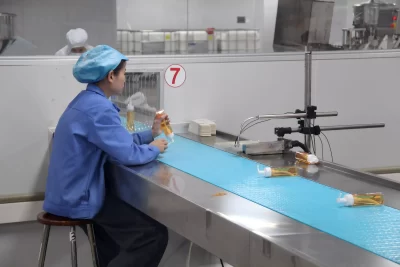
Smart Factories: Leading manufacturers have transitioned to AI-monitored emulsification and robotic filling lines. This minimizes human error and guarantees batch-to-batch consistency.
-
The Certification Gold Standard: At a minimum, your partner must hold ISO 22716 and GMPC certifications. In 2026, look for those with additional ESG (Environmental, Social, and Governance) ratings, as consumers now vet the ethics of the entire supply chain.
II. The Anatomy of a High-Tier Cosmetics Factory
How do you distinguish a world-class facility from a middle-of-the-road workshop? It comes down to two factors: the Lab and the Logic.
1. Evidence-Based Beauty: The Power of Clinical Validation
The era of “marketing fluff” is over. Consumers in 2026 demand data.
-
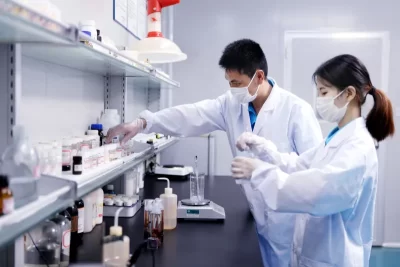
In-House Efficacy Testing: Does the manufacturer have a dedicated lab for patch testing, moisture retention analysis, and anti-aging clinical trials?
-
Raw Material Traceability: Top-tier OEM cosmetics manufacturers partner directly with global giants like BASF, DSM, or Evonik. If they can’t tell you exactly which farm their botanical extract came from, your brand’s transparency is at risk.

2. The “Agile” Supply Chain: Solving the MOQ Dilemma
The biggest pain point for emerging brands is the Minimum Order Quantity (MOQ).
-
Micro-Batching Capabilities: A forward-thinking manufacturer offers “flexible manufacturing,” allowing you to test the market with 1,000 units before scaling to 50,000.
-
Speed to Market: In 2026, trends change in weeks, not months. Your partner should be able to take a concept to a finished, shelf-ready product in 45 to 60 days.
III. 2026 Industry Frontiers: Is Your Manufacturer Future-Proof?
To rank on Google and capture the “Gen Alpha” and “Late Millennial” markets, your manufacturer must be proficient in the following three technical domains.
1. Synthetic Biology and “Green Chemistry”
We have moved past “Natural” into “Bio-identical.”
-
Sustainable Sourcing: Is the manufacturer using fermentation instead of chemical synthesis? Ingredients like recombinant human collagen and ergothioneine are now the gold standard for high-performance skincare.
-
Upcycled Beauty: Leading OEMs are now repurposing food industry by-products (like coffee grounds or fruit seeds) into high-potency cosmetic actives.
2. Sustainable Packaging and PCR Integration
Sustainability is no longer an “option”; it’s a regulatory requirement in many regions.
-
Circular Solutions: Does the factory support PCR (Post-Consumer Recycled) plastics, glass-only lines, or refillable pod systems?
-
Biodegradable Formulas: Beyond the bottle, the formula itself must be eco-tox tested to ensure it doesn’t harm aquatic life when washed down the drain.
3. Global Compliance: The Regulatory Shield
If you plan to sell on Amazon (Global), Sephora, or Tmall, your manufacturer must be a regulatory expert.
-
Multi-Region Mastery: They should provide documentation ready for the US FDA (MoCRA), EU CPNP, and China’s NMPA.
-
Safety Assessments: Every formula must come with a comprehensive Safety Assessment Report (SAR) signed by a certified toxicologist.
IV. Cost Management: Beyond the Unit Price
The cheapest quote is often the most expensive in the long run. To find true value, you must look at the “Total Cost of Ownership.”
1. Radical Cost Transparency (The BOM Breakdown)
A professional OEM cosmetics manufacturer provides a transparent Bill of Materials (BOM).
-
What’s Included: Ensure the quote covers stability testing, preservative challenge tests, and primary packaging compatibility.
-
Scale Economies: Discuss a “sliding scale” price model. As your brand grows, your unit cost should drop, allowing you to reinvest in marketing.
2. Added Value: Design and Market Intelligence
Top-tier manufacturers act as consultants.
-
Visual Strategy: Many offer in-house packaging design that isn’t just pretty but is “production-friendly,” saving you thousands in wasted materials.
-
Trend Forecasting: Because they manufacture for dozens of brands, they have a bird’s-eye view of what’s selling. Use their insights to pivot your product roadmap.
V. FAQ: What Every Founder Needs to Ask
| Question | Expert Insight |
| What is the typical MOQ for a new brand? | In 2026, expect 2,000–5,000 units for skincare and 1,000–3,000 per shade for color cosmetics. “Agile” factories may go lower for a premium. |
| How do I protect my custom formula? | Ensure your contract includes an “IP Ownership” clause. You should own the formula if you paid for the R&D, or at least have an exclusive right to use it. |
| Can I provide my own raw materials? | Most OEMs prefer to source materials to ensure quality control, but “toll manufacturing” is possible if your ingredients meet their strict QC standards. |
| How long does the R&D process take? | Standard “stock” formulas can be ready in 2 weeks. Custom “from-scratch” innovations typically take 3 to 6 months for stability and compatibility testing. |
Conclusion: Your Supply Chain is Your Brand
Choosing an OEM cosmetics manufacturer is the most significant investment you will make. In 2026, the winners won’t be the brands with the biggest ad spend, but the ones with the most stable, innovative, and ethical supply chains.
Don’t just look for a vendor; look for a partner who shares your vision for the future of beauty. Visit the labs, test the samples, and ask the hard questions about sustainability and data.