
1. Regulatory Compliance and Legal Verification: The Non-Negotiables
In the wake of China’s CSAR (Cosmetics Supervision and Administration Regulation) and the 2026 “Quality Enhancement Initiative,” compliance is your first filter.
1.1 Understanding CSAR and NMPA Licenses
A factory without the proper license is a liability. You must verify:
-
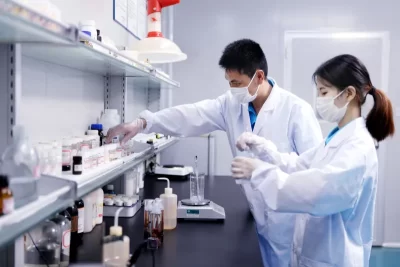
The Production License: Ensure it is current and covers the specific category of products you intend to manufacture (e.g., “General Liquid,” “Cream & Lotion,” or “Special Cosmetics” like sunscreens).
-
The Responsible Person (RP): Under Chinese law, every factory must have a designated Quality and Safety Officer with at least five years of industry experience. Ask for their credentials to ensure the factory isn’t just “renting” a license.
1.2 Verifying International Certifications: GMPC and ISO 22716
While local licenses are mandatory for manufacturing, international certifications are mandatory for quality assurance.
-
GMPC (Good Manufacturing Practice for Cosmetics): Essential for exporting to the US and EU. Verify the certificate via the issuing body (SGS, Intertek, or TUV) rather than just accepting a PDF.
-
ISO 22716: This is the global gold standard. In 2026, look for factories that also hold ISO 14001 (Environmental Management) and ISO 45001 (Occupational Health), as these indicate a mature, sustainable corporate structure.
2. R&D Capabilities: Evaluating Innovation vs. Imitation
In 2026, the value of a factory lies in its “Brain” (the R&D lab), not just its “Hands” (the assembly line).
2.1 Formulation Library and Patent Portfolio
A top-tier ODM (Original Design Manufacturer) should offer more than just “me-too” products.
-
The Formula Database: Does the factory have a library of 10,000+ stable, market-tested formulas? Ask about their “Clean Beauty” and “Waterless Beauty” options.
-
Proprietary Ingredients: Evaluate if they have patents for specific extraction methods (e.g., fermentation, supercritical CO2 extraction) or unique delivery systems like liposomal encapsulation.
2.2 Efficacy Testing and Claim Substantiation
With global regulations tightening on “False Claims,” a factory must prove its products work.
-
In-house Efficacy Labs: Does the factory have equipment like VISIA skin analyzers or moisture meters to provide preliminary data?
-
Third-party Testing Networks: Ensure they have established relationships with certified labs for human clinical trials, SPF testing, and dermatological safety assessments.
3. Manufacturing Infrastructure and Smart Technology
Physical inspection remains a cornerstone of how to evaluate a cosmetics factory in China.
3.1 Cleanroom Standards and Automation
Cosmetics are highly susceptible to microbial contamination.
-
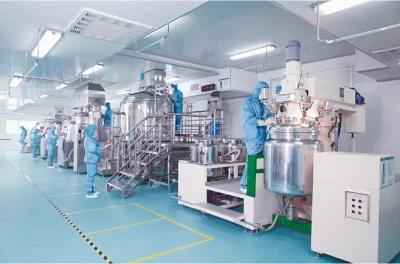
Class 100,000 Cleanrooms: Ensure the production and filling areas meet the “100,000-grade” purification standard (ISO 8). Check the air pressure differentials and the personnel entry protocols.
-
High-End Equipment: Look for vacuum emulsifying mixers from reputable brands. In 2026, the best factories use Smart Manufacturing (Industry 4.0), where AI-monitored systems ensure the consistency of every batch.
3.2 Capacity Flexibility and Lead Times
Your partner must be able to scale with your success.
-
Small-Batch Agility: Can the factory support a “test and learn” strategy with MOQs (Minimum Order Quantities) of 1,000–3,000 units?
-
ERP/MES Integration: Ask if they use Manufacturing Execution Systems (MES). This allows for real-time tracking of your order, from raw material weighing to final packaging, significantly reducing lead-time uncertainty.
4. Quality Control (QC) Systems: Beyond the Final Product
Quality is a process, not a destination. You need to see the “closed-loop” system in action.
4.1 IQC, IPQC, and FQC Frameworks
-
IQC (Incoming Quality Control): How do they test raw materials? Do they verify the COA (Certificate of Analysis) for every ingredient?
-
IPQC (In-Process Quality Control): Are there checks every hour on the production line for viscosity, pH, and color consistency?
-
FQC (Finished Quality Control): Does the factory perform “Drop Tests” for packaging and “Stability Tests” (45°C/50°C for 3 months) before shipping?
4.2 Raw Material Traceability and Safety
-
Global Sourcing: Do they work with reputable ingredient suppliers like BASF, Symrise, or Croda?
-
Batch Traceability: In a mock audit, ask the factory to trace a random finished product back to the specific batch of raw materials and the specific operators on duty. They should be able to do this in under 30 minutes.
5. Supply Chain Integration and Global Logistics
A great factory should act as a “one-stop-shop” to minimize your operational friction.
5.1 Packaging Sourcing and Sustainable Solutions
The packaging is as important as the formula.
-
Eco-friendly Options: In 2026, evaluate if the factory can source PCR (Post-Consumer Recycled) plastics, refillable designs, or mono-material packaging that is 100% recyclable.
-
Compatibility Testing: Does the factory offer in-house testing to ensure the formula doesn’t react with the bottle or pump over time?
5.2 Regulatory Support for Global Markets
If you are selling outside China, the factory must understand your local laws.
-
US Market: Are they prepared for MoCRA (Modernization of Cosmetics Regulation Act) requirements?
-
EU Market: Can they provide the PIF (Product Information File) and help with CPNP notifications?
-
Halal/Vegan Certification: If targeting Southeast Asia or specific niches, check if the factory has the necessary facility certifications.
6. Communication and Business Transparency: The Soft Skills
The biggest “hidden cost” in China sourcing is poor communication.
6.1 Project Management and Responsiveness
-
Dedicated PMs: Does the factory assign a dedicated Project Manager who speaks your language and understands your brand’s DNA?
-
Digital Transparency: Will they provide a project timeline (Gantt chart) and weekly status updates?
6.2 Audit Accessibility
-
Open-Door Policy: A factory that refuses a third-party audit (e.g., by SGS or QIMA) is a major red flag.
-
Virtual Audits: For 2026, top-tier factories offer high-definition 360° virtual tours and “Live Stream” QC sessions for international clients who cannot travel.
Conclusion: The Ultimate Evaluation Checklist
To successfully evaluate a cosmetics factory in China, use this simplified scorecard:
| Criteria | Ideal Performance | Red Flag |
| Legal | Current NMPA license + GMPC/ISO 22716 | Expired licenses or mismatched addresses |
| R&D | In-house lab with patented formulas | Only “ready-made” generic formulas |
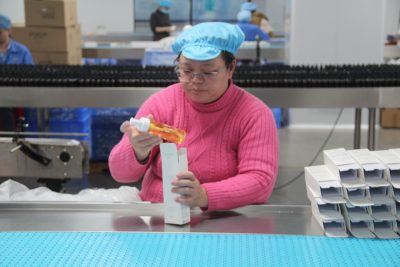
| Cleanliness | Class 100,000 cleanroom with strict protocols | Visible dust or lack of protective gear |
| QC | Full traceability within 30 minutes | No stability or compatibility testing |
| Compliance | Deep knowledge of MoCRA/EU/CSAR | No idea about international labeling laws |
Next Step for You:
Would you like me to provide a detailed list of “Audit Questions” to send to potential Chinese factories? Or perhaps you need a comparison of the top 5 cosmetic manufacturing hubs in China (like Guangzhou vs. Shanghai)?