
In today’s competitive beauty market, creating a unique brand is no longer exclusive to large corporations. Private Label and Contract Manufacturing offer entrepreneurs, influencers, existing retailers, and visionaries a fast track to success. However, the starting point and most critical decision on this path is choosing the right Private Label Cosmetics Manufacturer. This is not just about finding a factory to produce your products; it’s about selecting a strategic partner that will determine your brand’s quality, compliance, innovative capability, and ultimate market reputation.
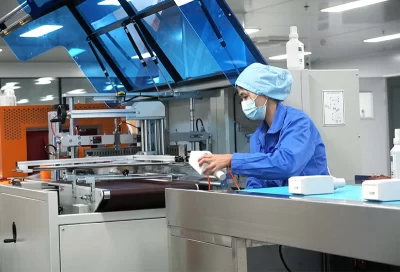
This article serves as your comprehensive guide, delving into every key dimension you need to examine when choosing a private label cosmetics manufacturer. We will move beyond surface-level questions like “Minimum Order Quantity (MOQ)” and “price” to explore formulation, compliance, R&D, sustainability, and how to build a true partnership to ensure your brand is not only born but thrives.
Chapter 1: Core Concepts of Private Label Cosmetics Manufacturing and Your Opportunity
Before diving into screening manufacturers, it’s crucial to understand the core models within the private label space and your own opportunity.
Private Label vs. Contract Manufacturing: Clarifying the Difference
Although often used interchangeably, there are subtle yet important distinctions:
-
Private Label: Typically refers to a manufacturer that already has a portfolio of established, market-tested formulas and products. You can choose products from their existing catalog (like a Vitamin C serum, a matte liquid lipstick) and sell them under your own brand name, logo, and packaging. This approach offers fast market entry, lower initial costs, and reduced risk, but product differentiation may be limited.
-
Contract Manufacturing: This is a deeper form of collaboration. You (the brand owner) approach a manufacturer with your unique formula, innovative concept, or specific ingredient requirements, commissioning them to develop and produce from scratch. This offers extremely high product uniqueness and control over intellectual property, but correspondingly requires higher R&D investment, longer development cycles, and more rigorous involvement in quality control.
For most startup brands, Private Label is the ideal starting point. As the brand grows and gains precise insight into market demands, gradually transitioning to or combining contract manufacturing is key to building a long-term competitive moat.
Why Now is the Golden Age for Entering Private Label Beauty
The market environment has never been more favorable for emerging brands:
-
Diversified Consumer Demand: Consumers crave niche, story-driven brands that align with specific values (clean, vegan, cruelty-free, sustainable) over homogeneous giant-brand products.
-
Social Media & DTC Models: Channels like Instagram, TikTok, and independent websites allow brands to reach consumers directly, without relying on traditional retail shelves.
-
Specialized Supply Chains: Top-tier Private Label Cosmetics Manufacturers have modularized and refined their services, offering flexible solutions from micro-orders to large-scale production for clients of all sizes.
Your opportunity lies in leveraging a professional manufacturer’s decades of experience, infrastructure, and compliance systems to rapidly, safely, and qualitatively transform your creative idea into a product on the shelf.
Chapter 2: In-Depth Evaluation: The 7 Golden Criteria for Choosing a Manufacturer
Price and Minimum Order Quantity (MOQ) are important, but they should not be the deciding factors. Here are the seven core areas you must investigate deeply.
Criterion 1: Compliance & Certifications – The Non-Negotiable Baseline
This is the brand’s “lifeline.” A compliant manufacturer is your first and most critical line of defense in a stringent global regulatory environment.
-
Key Certifications:
-
cGMP (Current Good Manufacturing Practice): A U.S. FDA requirement ensuring products are manufactured under consistent quality standards.
-
ISO 22716 (Cosmetics GMP): The internationally recognized standard for Good Manufacturing Practices for cosmetics.
-
FDA Registration & Listing: The manufacturing facility must be registered with the FDA, and products must be properly listed.
-
Cruelty-Free Certifications (Leaping Bunny, PETA): If your target market values this, the manufacturer must provide valid certification.
-
Organic/Vegan Certifications (e.g., COSMOS, Vegan Society): If producing relevant products, the manufacturer must have appropriate credentials.
-
-
Deep-Dive Questions: Inquire about their specific Quality Assurance (QA) and Quality Control (QC) processes. How are raw materials inspected upon receipt? How are stability and microbial challenge tests conducted on semi-finished and finished products? Is there detailed batch documentation for traceability?
Criterion 2: R&D Capability & Formula Library – The Engine of Product Innovation
The manufacturer’s “brain” determines the efficacy and uniqueness of your products.
-
Depth & Breadth of Formula Library: Assess if their library covers the latest trends (e.g., blue light protection, microbiome skincare, waterless formulas). Are stock formulas regularly updated?
-
Strength of R&D Team: Do they have experienced chemists, dermatologists, or formulators? Can they perform custom adjustments based on your ideas (e.g., changing active ingredient concentration, adjusting texture/fragrance)?
-
Ingredient Philosophy: Do they specialize in certain ingredient types (e.g., natural/organic ingredients, high-performance synthetics, popular Korean/Japanese ingredients)? Does this align with your brand philosophy?
Criterion 3: Production Facilities & Technological Level – The Guarantee of Quality & Capacity
“Where” and “how” products are made directly impacts consistency and safety.
-
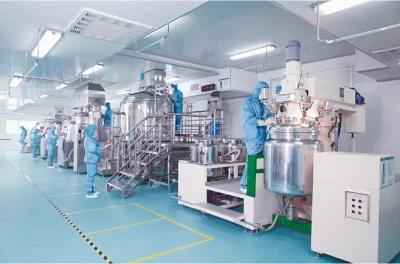
Factory Tour (Virtual or Physical): Modern workshops should be clean, with clearly defined zones (raw materials, production, filling, packaging). Check if equipment is advanced and well-maintained.
-
Capacity & Flexibility: Can they handle your order alongside larger clients’ orders without compromising quality? What are the cleaning protocols when switching production lines between different products?
-
Technical Expertise: Are they proficient in manufacturing specific product types? For example, some excel in sterile-filling serums and ampoules, while others are experts in complex pressed powders and lip gloss filling.
Chapter 3: Beyond Production: Value-Added Services from Manufacturers
The difference between a top-tier manufacturer and an average factory often lies in the extent of “services” they provide to empower your brand.
Service 1: Full-Spectrum Support from Design to Logistics
Look for a partner that offers a “one-stop” solution to simplify your operations:
-
Packaging Design & Sourcing: Do they have partnered packaging suppliers or an in-house design team? Can they help you make informed choices from vast packaging options (glass, plastic, sustainable materials) and manage sourcing/inventory?
-
Regulatory & Copy Support: Can they assist in ensuring product labels (INCI lists, warnings), and marketing copy comply with regulations in your target sales destinations (e.g., USA, EU, China)?
-
Warehousing & Fulfillment: Do they offer finished goods storage, labeling, and direct shipping to your customers or e-commerce platforms (Dropshipping)? This can significantly ease the logistical burden for startup teams.
Service 2: Marketing & Brand Incubation Support
Some leading manufacturers now act as “brand incubators.”
-
Content Creation: Can they provide high-quality product photography, videos, or 3D renderings?
-
Market Insights: Do they regularly share market trend reports and analysis of popular ingredients?
-
Sample & Trial-Size Support: Can they provide substantial samples at reasonable costs for your market testing, KOL seeding, or customer subscription boxes?
Chapter 4: Sustainability & Ethics: Essential Elements for Modern Beauty Brands
Today’s consumers vote with their wallets, supporting brands that align with their values. Your manufacturer must be in sync with you on these fronts.
Environmental Sustainability: Green Commitments from Ingredients to Packaging
-
Green Chemistry: Do formulas prioritize biodegradable ingredients? Is the water footprint reduced (waterless formulas)?
-
Responsible Sourcing: Are ingredients sourced from sustainably managed origins? Are fair-trade ingredients used?
-
Packaging Ecology: Do they offer packaging options that are recyclable, refillable, or use Post-Consumer Recycled (PCR) materials? Are they committed to reducing unnecessary secondary packaging?
Social Ethics & Corporate Responsibility
-
Labor Rights: Ensure the manufacturer provides a safe, fair work environment and adheres to ethical labor practices.
-
Community Engagement: Does the manufacturer have initiatives to give back to the community or support relevant public welfare causes?
-
Transparency: What is their level of supply chain transparency? Can the origin of key ingredients be traced?
Chapter 5: Building a Successful Partnership: From Inquiry to Long-Term Collaboration
Selecting a manufacturer is a two-way evaluation process, with the goal of establishing a long-term, mutually trusting partnership.
Effective Communication & Inquiry: How to Ask the Right Questions
During initial contact, provide a clear brief and ask structured questions:
-
“For a startup brand like mine (with an estimated first order of XXX units), what is your typical cooperation process?”
-
“Beyond unit price and MOQ, please detail all potential costs: development fees, mold fees, sampling fees, compliance documentation fees.”
-
“Our target market is XX. What support can you provide regarding product registration, labeling, and testing?”
-
“Can you provide at least 2-3 case studies of successful clients with a brand positioning similar to ours (under NDA)?”
Managing Expectations & Avoiding Common Pitfalls
-
Be Realistic About Timelines: Allow ample time from sampling to mass production (typically 3-6 months or longer).
-
Test Samples Rigorously: Conduct comprehensive testing on each sample round: feel, fragrance, stability, packaging user experience.
-
The Contract is Crucial: It must clearly cover all details: quality standards, delivery timelines, payment terms, intellectual property ownership (especially for custom formulas), liability division, and termination clauses. Review by a legal professional is recommended.
Chapter 6: A Global Perspective: Analyzing Strengths of Manufacturers by Region
Supplier Comparison: Certifications and US Market Access
If you are selling private label cosmetics manufacturer: the ultimate guide to into the United States, the certification list is where supplier tiers separate most sharply. The table below compares what each level of compliance investment actually covers, and what it still leaves you responsible for.
| Requirement | What it covers | Who it applies to | Who maintains it |
|---|---|---|---|
| ISO 22716 | Good Manufacturing Practice for cosmetics | Factory | Factory, audited annually |
| FDA facility registration | Listing cosmetics manufacturing and repacking sites | Factory in the US facility listing | Factory, renewed biennially |
| MoCRA Responsible Person | Named US party accountable for adverse event reporting | Brand owner / importer | Brand owner, not the factory |
| Cosmetic product labelling (MoCRA) | Safety substantiation, accurate ingredient and net-content declarations | Brand owner | Brand owner |
| Prop 65 assessment | California-specific exposure risk labelling | Brand owner selling into California | Brand owner |
| COA per batch | Identity, purity and microbiological results for each lot | Brand owner / ingredient buyer | Factory, issued per shipment |
The most common failure we see is a factory holding a valid ISO certificate while the brand owner has never appointed a US Responsible Person. Ask specifically who holds that role.
Want numbers for your own product? Send us your target category,
packaging preference and estimated annual volume, and we will come back with a written quotation and MOQ options —
usually within one business day.
Consider manufacturers in different regions based on your target market, budget, and brand positioning.
Korean & Japanese Manufacturers: Benchmarks of Innovation & Quality
-
Strengths: Renowned globally for cutting-edge R&D, unique textures (e.g., watery gels, light creams), innovative ingredients (e.g., fermentation filtrates, peptide complexes), and exquisite packaging design. Particularly suitable for creating high-end, efficacy-driven skincare brands.
-
Considerations: Prices are generally higher, MOQs may be larger, and communication may require overcoming language and cultural barriers.
Chinese Manufacturers: Masters of Supply Chain & Cost-Effectiveness
-
Strengths: Possess the world’s most complete and efficient cosmetics supply chain, encompassing everything from packaging materials to raw ingredients. Highly advantageous in cosmetics production (lipsticks, eyeshadow palettes). High flexibility, accepting a wide range of MOQs from low to high, with outstanding cost-effectiveness.
-
Considerations: The market has mixed quality, requiring careful vetting. Must critically assess their compliance, R&D capability, and original design ability, not just cost.
European & American Manufacturers: Convenience for Localization & Market Access
-
Strengths: No language barrier, deep understanding of local regulations and consumer preferences. Short logistics times, suitable for rapid restocking. Have strong expertise in areas like clean beauty and organic certification.
-
Considerations: Production costs are typically the highest, suitable for mid-to-high-end brands positioning “locally made” as a core selling point.
Conclusion: Your Brand Begins with the Right Choice
Choosing a Private Label Cosmetics Manufacturer is one of the most important business decisions in your brand journey. It is not a simple supplier procurement but selecting an extended team that transforms your vision into a tangible reality and guards your brand’s reputation at every step.
Do not rush. Invest time in research, request and test samples, tour facilities, and ask tough questions. An excellent manufacturer will not shy away from this scrutiny but welcome it, as it demonstrates your professionalism and sincerity as a brand owner.
In the captivating beauty industry, success belongs to brands that perfectly combine exceptional products, compelling stories, and a robust supply chain. Now, you possess the knowledge map to find and secure that key partner. The next step is to begin your exploration and discover the Private Label Cosmetics Manufacturer that can write your brand legend with you.