
In an era defined by “skintellectuals” and the explosion of Direct-to-Consumer (DTC) brands, creating your own skincare line is a dream for many entrepreneurs and beauty enthusiasts. However, how to manufacture skincare products involves much more than just mixing ingredients. It is a sophisticated discipline that blends dermatological science, chemical engineering, supply chain management, and strict regulatory compliance.
Whether you are starting with small-scale artisanal batches or planning to partner with a large-scale contract manufacturer, this article pulls back the curtain on the skincare industry to guide you through the journey from concept to shelf.
Phase 1: Market Research and Brand Positioning (Beyond the Label)
Before touching a single chemical raw material, the most critical step is “strategic groundwork.” Most failed skincare brands don’t die because of poor quality, but because of vague positioning.
Identifying Your Niche Market
The skincare market is a “red ocean.” Launching a generic “moisturizer for all skin types” is a recipe for invisibility. You must carve out a specific niche.
-
Define Your Demographic: Don’t just say “young women.” Be precise: “Professional women aged 25-35 dealing with ‘screen fatigue’ and early signs of aging.”
-
Specific Use Cases: Is it for post-workout recovery, or perhaps a barrier-repair cream for post-medical aesthetic procedures?
-
Core Philosophy: Will you lead with Clean Beauty, Vegan-certified, Skinimalism (minimalist routines), or High-Performance “clinical” actives?
Competitive Analysis and Consumer Pain Points
Your product must solve an existing problem. Purchase products from your competitors (especially those you consider benchmarks) and analyze:
-
The Ingredient Deck: What are the hero actives? What preservative system do they use?
-
Sensory Profile: Is it lightweight, greasy, or tacky?
-
The “Gap” in Reviews: Look at one-star reviews on Amazon or Sephora. What are users complaining about? (e.g., “Too much fragrance,” “The pump broke,” “Caused breakouts”). These complaints are your opportunities.
Phase 2: The Core Steps of Skincare Formulation
This is the most technical aspect of manufacturing. A formula is not just a list of ingredients; it is a meticulously designed structure.
Understanding the “Big Three” Components
A professional skincare formula consists of three essential parts:
-
Active Ingredients: The “soul” of the product. Think Vitamin C (brightening), Retinol (anti-aging), or Salicylic Acid (exfoliation). You must determine the clinically effective concentration.
-
The Base (Vehicle): This carries the actives—usually water (aqueous phase) and oils (lipid phase). To blend these, you must use emulsifiers.
-
Functional Ingredients:
-
Rheology Modifiers (Thickeners): These determine if your product flows like water or feels like a rich butter.
-
Preservatives: Non-negotiable. Any water-based product is a breeding ground for bacteria. Without a broad-spectrum preservative system, your product will mold within days.
-
Penetration Enhancers: These help actives bypass the skin’s barrier to reach deeper layers.
-
DIY Prototyping vs. Professional Lab R&D
If you are moving toward commercialization, do not rely solely on “kitchen chemistry.”
-
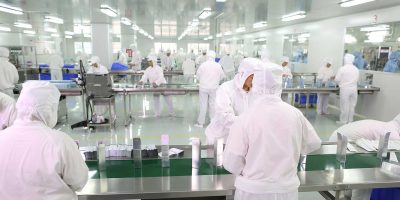
The Limits of DIY: Home environments lack sterility, and without high-shear homogenization, products often separate or oxidize rapidly.
-
Laboratory R&D: Professional formulators perform “Stability Testing.” They place samples in ovens (45°C) and freezers (-10°C) for weeks to ensure the product won’t discolor, separate, or degrade during shipping and shelf life.
Phase 3: Supply Chain Strategy—OEM, ODM, or OBM?
Once your formula concept is ready, you need a production partner. For startups, contract manufacturing is the most viable route.
Deciphering OEM vs. ODM
Choosing the wrong model can impact your profit margins and intellectual property (IP) rights.
| Model | Definition | Best For | Pros | Cons |
| OEM (Original Equipment Manufacturer) | You provide the formula; the factory provides the labor/equipment. | Brands with unique IP or proprietary recipes. | You own the formula; full control over quality. | Requires high R&D expertise; higher initial cost. |
| ODM (Original Design Manufacturer) | The factory provides a “private label” formula; you add your logo. | Marketing-focused teams wanting a fast launch. | Fast speed-to-market; lower R&D investment. | You don’t own the formula; others may sell the same product. |
How to Vet a Skincare Manufacturer
Don’t choose based on price alone. Look for these “trust signals”:
-
GMPC/ISO 22716 Certification: The international baseline for cosmetic manufacturing.
-
Minimum Order Quantity (MOQ): Large factories may require 5,000+ units, while boutique labs might accept 500–1,000 units.
-
In-House Microbiological Testing: Ensure they can test for pathogens on-site.
-
Turnaround Time: How long does it take for them to provide a sample? This indicates their future production agility.
Phase 4: Compliance, Registration, and Safety Testing
Before your product hits the market, you must clear the legal hurdles. This is where professional credibility is built.
Navigating Global Regulations (FDA, EU, NMPA)
-
USA (FDA/MoCRA): Under the Modernization of Cosmetics Regulation Act (MoCRA), the FDA has increased oversight. You must register your facility and list your products.
-
European Union (CPNP): One of the strictest regions. You need a “Responsible Person” and a Product Information File (PIF) that includes a comprehensive safety report.
-
China (NMPA): Requires rigorous filing and safety assessments, especially for “special use” cosmetics like sunscreens or whitening agents.
Mandatory Safety Tests
To avoid recalls and lawsuits, these tests are essential:
-
Microbiological Testing: Confirms the absence of harmful bacteria and yeast.
-
Preservative Challenge Testing (PET): Lab technicians intentionally “infect” the product to see if the preservatives effectively kill the microbes.
-
Patch Testing: Human clinical trials to ensure the product doesn’t cause irritation or allergic reactions.
-
Compatibility Testing: Ensures the formula doesn’t react with the packaging (e.g., essential oils melting plastic).
Phase 5: Packaging Design and Production Logistics
Consumers see the packaging long before they feel the texture of the cream.
Container Choice and Technical Compatibility
Packaging is science, not just aesthetics.
-
Airless Pumps: Best for easily oxidized ingredients (Vitamin C, Retinol). They are more expensive but significantly extend shelf life.
-
Glass vs. Plastic: Glass feels premium but is heavy and breakable. PET/PP plastics are versatile and recyclable but must be checked for chemical compatibility with your formula.
-
The “Leach” Test: Ensure that no chemicals from the bottle migrate into your high-end serum.
Scaling Up: Pilot Runs and QC
Before a mass run of 10,000 units, perform a Pilot Run.
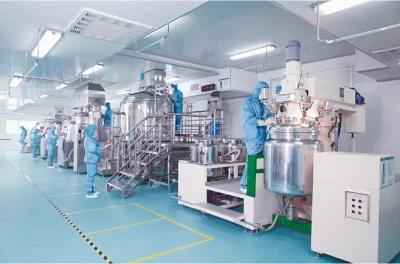
A formula that works in a 1-liter beaker might behave differently in a 500-kilogram industrial vat. Issues like aeration (bubbles), heating inconsistencies, or sheer-rate changes often appear during scale-up.
Expert Tip: Always be present for the “First Article Inspection” to compare the mass-produced batch against your lab-approved benchmark for color, scent, and viscosity.
Phase 6: Brand Launch and Initial Marketing
How do you turn a product into a brand?
Building a “Founding Community”
Don’t wait for the inventory to arrive. Share your “Building in Public” journey on TikTok or Instagram. Invite your audience to vote on scents or packaging designs. This creates a community of “co-creators” who are ready to buy on day one.
Radical Transparency
Today’s consumers demand honesty. On your landing page:
-
Explain the purpose of every ingredient in your INCI list.
-
Share photos of your production facility.
-
Post summaries of your safety and efficacy test results.
Trust is the ultimate currency in the skincare industry.
Conclusion: Manufacturing is a Marathon, Not a Sprint
Learning how to manufacture skincare products is just the beginning. The process is filled with hurdles—formulas may fail, packaging may be delayed, and regulations may change. However, the moment you see a customer post a review saying your product “actually fixed their skin,” the effort becomes worth it.