The global beauty market is growing rapidly, and with it comes a massive demand for fast, cost-effective, and safe production. For independent beauty brands, corporate labels, and e-commerce entrepreneurs, finding the right manufacturing partner is the single most critical decision for long-term survival.
When searching for the world’s best cosmetic supply chains, all roads inevitably lead to Southern China. Specifically, finding a GMP certified cosmetic factory in Guangzhou has become the gold standard for brands aiming to balance premium product quality with highly scalable manufacturing solutions.
But why is Guangzhou the focal point of the global cosmetic supply chain, and why is Good Manufacturing Practice (GMP) non-negotiable for international export? This comprehensive guide breaks down everything you need to know about navigating the manufacturing landscape in Guangzhou to secure a reliable, compliant, and elite OEM/ODM partner.
Why Guangzhou is the Capital of Cosmetic Manufacturing
Guangzhou, the capital of Guangdong province, is indisputably the heart of China’s cosmetics sector. The city accounts for more than half of China’s total cosmetic production facilities, with the vast majority concentrated in specialized industrial hubs like Baiyun District and Huangpu District.
When you source from this region, you are not just partnering with an individual factory; you are plugging into a massive ecosystem that includes:
-
Raw Material Abundance: Direct proximity to top-tier global and domestic chemical suppliers, lowering formulation lead times.
-
Packaging Innovations: Thousands of localized suppliers specializing in everything from sustainable glass dropper bottles to high-tech, airless acrylic pumps.
-
Logistics Infrastructure: Streamlined shipping routes out of Nansha Port and Guangzhou Baiyun International Airport, allowing seamless export to the US, Europe, Southeast Asia, and the Middle East.
However, because the barrier to entry for setting up a workshop can be low, the quality gap between facilities can be huge. That is where international regulatory compliance separates the amateurs from the true industry leaders.
What Does “GMP Certified” Actually Mean for Your Brand?
In the cosmetics industry, GMP stands for Good Manufacturing Practices. Specifically for cosmetics, this aligns closely with the ISO 22716 standard. It represents a strict set of operational guidelines designed to ensure that products are consistently produced, controlled, and checked according to global quality metrics.
When you work with an authorized GMP certified cosmetic factory in Guangzhou, you are ensuring that the facility adheres to strict operational parameters.
1. Advanced Air Purification (Cleanroom Standards)
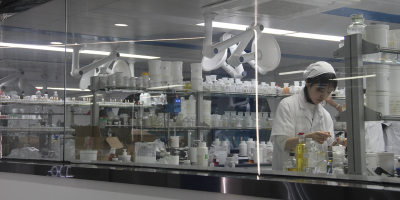
A verified GMP factory operates 100,000-grade or 300,000-grade cleanrooms. As shown in the image above, technicians must wear protective headgear, masks, and specialized suits. Air pressure, humidity, and temperature are digitally regulated to prevent any microbial contamination during the mixing, filling, and sealing processes.
2. Rigorous Raw Material Testing
Before any ingredient—whether it is an active like caffeine, a botanical oil like Batana, or a simple emulsifier—touches the mixing vats, it must undergo strict laboratory assay tests. This guarantees the purity of the ingredients and ensures they are free from heavy metals or banned toxins.
3. Total Traceability & Batch Consistency
GMP rules mandate a complete paper and digital trail for every single batch of cosmetics produced. If an issue arises with a finished product months later, the factory can immediately trace it back to the exact machine, technician, production time, and raw material batch used.
Standard Factory vs. GMP Certified Factory
To understand why investing in a premium partner saves your brand money in the long run, consider how a standard factory compares to an elite GMP-certified setup:
| Feature | Standard Guangzhou Workshop | GMP Certified Factory (Guangzhou) |
| Air Quality & Control | Basic ventilation; higher risk of ambient micro-contamination. | 100,000-grade cleanrooms with positive air pressure filtration. |
| Water Purification | Standard filtered water or basic reverse osmosis. | Multi-stage EDI (Electrodeionization) ultra-pure water systems. |
| Regulatory Compliance | Domestically compliant; high risk of failing international customs audits. | Fully compliant with US FDA (GMPC) and EU (ISO 22716) export laws. |
| Formulation Stability | Minimal testing; formulas may separate or alter color over time. | Mandatory freeze-thaw stability, microbial challenge, and compatibility testing. |
| Documentation | Patchy records; difficult to provide complete COA (Certificate of Analysis). | Full batch records, MSDS sheets, and instantly accessible trace logs. |
Crucial Business Advantages of Partnering with a GMP Factory
If you are importing cosmetics into highly regulated regions like North America or the European Union, working with an uncertified workshop is a major liability. Partnering with a certified manufacturer offers several key business advantages:
Seamless Customs and Regulatory Clearance
To legally register and sell skin or makeup products in western markets, you must submit detailed product information. A GMP-certified partner easily provides the necessary paperwork, including:
-
COA (Certificate of Analysis)
-
MSDS (Material Safety Data Sheet)
-
Stability Testing Reports
-
In-house microbiological test logs
Without these documents, your shipment risks being seized at customs, resulting in lost inventory and fines.
Shielding Your Brand Reputation
In the internet era, a single batch of contaminated lotion or skin irritation complaints can destroy a beauty startup overnight. GMP certification drastically minimizes the risk of recall, protecting your capital and keeping your brand’s reputation secure.
Access to Cutting-Edge R&D
GMP certified cosmetic factories in Guangzhou routinely invest millions into their research and development labs. They employ veteran cosmetic chemists who can help you engineer custom formulations, reverse-engineer trending viral products, or optimize clean-beauty formulas that avoid synthetic parabens, sulfates, and formaldehydes.
How to Verify a Factory’s GMP Status in Guangzhou
Many trading companies and low-tier factories use stock images or fake certificates on online directories to look like high-end manufacturers. Here is how you can verify a factory’s status like an industry professional:
Step 1: Check the Registration Name
Ensure the name on the GMP certificate perfectly matches the business license  and the physical factory address.

Step 2: Request the Issuing Body’s Verification Track
Legitimate GMP certifications are issued by globally trusted third-party inspection firms such as SGS, Intertek, or Bureau Veritas. Cross-check the certificate ID directly on the auditor's public portal.

Step 3: Evaluate via Video Consultation or Live Stream
If you cannot visit the facility in Baiyun or Huangpu yourself, request a live video tour. Demand to see the sanitization entrance showers, the mixing workshop, and the automated filling lines to confirm operational standards.
Finding the Perfect OEM/ODM Balance
When you reach out to a GMP certified cosmetic factory in Guangzhou, you will need to determine if you want OEM or ODM services:
-
OEM (Original Equipment Manufacturer): You bring the exact formulation and packaging specifications. The factory functions purely as your high-efficiency production house.
-
ODM (Original Design Manufacturer): The factory provides a turnkey solution. You select one of their pre-tested, high-performance stock formulas, choose a bottle template from their catalog, and apply your custom label design. This is perfect for private label brands looking to launch quickly.
A Note on B2B Inquiries and MOQs
High-end GMP factories maintain strict Minimum Order Quantities (MOQs) to justify setting up automated assembly lines. While basic workshops might accept orders of 500 units, a certified facility typically requires 1,000 to 5,000 units per SKU for skincare, and sometimes more for specialized makeup products like liquid lipsticks or foundations.
When you prepare your inquiry, ensure you have your approximate target volume, product type, and preferred launch timeline ready to help the factory process your quote efficiently.